
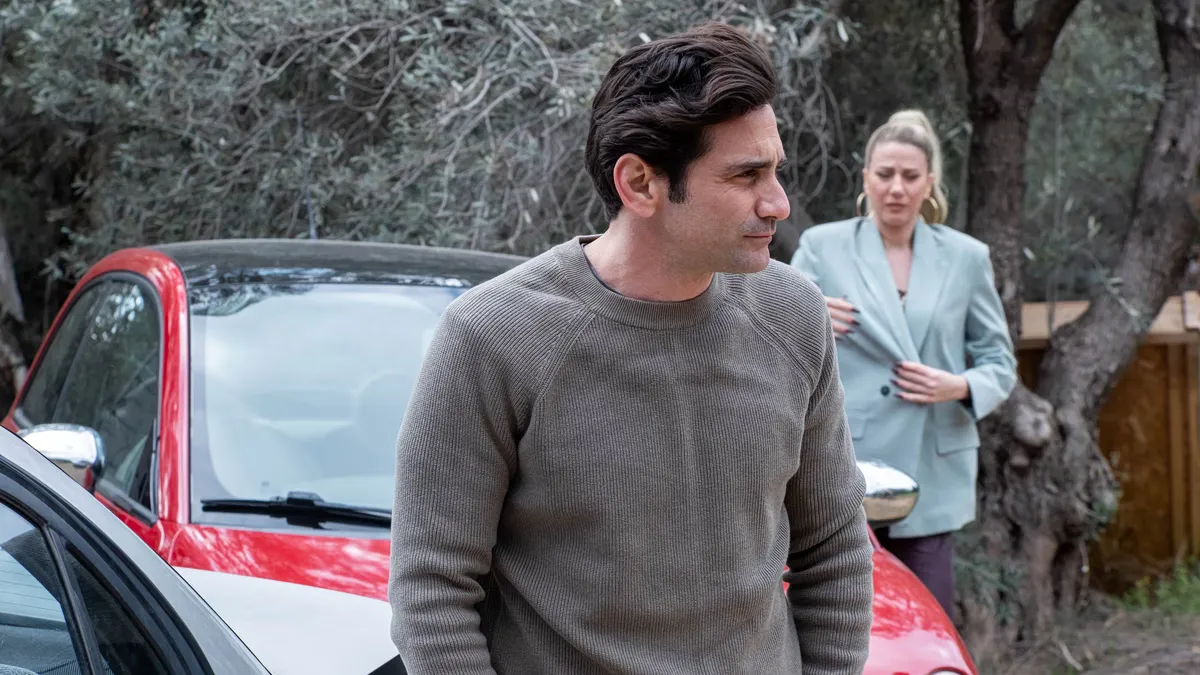
In einem aufrichtigen Fernsehinterview spricht der beliebte Schauspieler Odysseas Papaspiliopoulos über die tiefen Verbindungen zwischen seinen Rollen und seinem persönlichen Wunsch nach Flucht aus dem Alltag. Er reflektiert dabei sehr ehrlich über das unaufhaltsame menschliche Bedürfnis nach Anerkennung und Bestätigung durch andere. Der Künstler gibt tiefe Einblicke in seine Gedankenwelt und wie die Arbeit vor der Kamera sein Selbstbild prägt. Es ist ein Gespräch über die Balance zwischen öffentlicher Wahrnehmung und privater Sehnsucht nach Ruhe. Dabei thematisiert er auch die Herausforderungen der ständigen medialen Präsenz.
How does the character Iordanis reflect the actor's own identity?
Odysseas Papaspiliopoulos finds a profound sense of familiarity in the character of Iordanis from the MEGA series 'Camping'. During his appearance on the morning show 'Chamoela kai pali!', the actor explained that the character is not a distant persona but rather an extension of his own complexities. He noted that Iordanis embodies elements of his own hesitation, modesty, and personal difficulties.
The narrative arc of Iordanis involves a man driven by desperate choices, such as attempting to steal money from the mafia. This plot point highlights the character's struggle against circumstance, yet Papaspiliopoulos emphasizes that Iordanis remains deeply honest despite these errors. The character's journey is marked by a sense of integrity that survives even his most desperate plans. The interaction between Iordanis and the character Sophocles serves as a pivotal emotional anchor in the series. Sophocles, described as being 'cut from a different cloth,' enters the scene as a protector of the camping site, but through Iordanis's presence there, the two gradually form a friendship, transforming a dangerous situation into an unexpected bond.
The psychological bond between actor and role
For Papaspiliopoulos, the connection to a role is measured by how much of his true self he can inject into the performance. He stated that he has never played a part where he felt a total disconnect, suggesting that the most successful portrayals are those that mirror the actor's internal landscape. He noted that he hasn't played a role where he would say "that's not me," nor one where he would say "this is exactly how I am," but rather that there is always a sense of familiarity within the character.
This intimacy allows the audience to connect with the character's vulnerabilities on a visceral level. By finding pieces of himself in the characters he portrays—his own 'deilia' (hesitation) or 'systoli' (modesty)—he bridges the gap between fiction and reality, making the performance feel less like an act and more like a shared human experience.
Why is the concept of 'escape' so central to his life and work?
The theme of escape serves as both a narrative device in 'Camping' and a recurring thought in Papaspiliopoulos's personal life. He described the setting of the camping site as a parallel reality where the harsh edges of daily life are softened, providing a sanctuary for characters who are essentially 'fugitives of life.' In this environment, the usual sharp corners of existence are blunted, allowing characters like Iordanis to feel better, even if the new reality they inhabit is inherently dangerous and precarious.
However, the actor admitted that the desire for escape is a constant mental presence for him. He confessed that the thought of escape is on his mind every single day and that he struggles with this impulse in his actual life. Despite this urge, he remains tethered to his current existence by the life he has constructed and the 'deilia' (hesitation) that holds him back. He views the theater as a vital outlet where these anxieties and the impulse to flee can be safely discharged and processed. For him, the stage is not just a place of work, but a space where the pressures of reality are externalized.
What role does theater play in his artistic exploration?
Beyond television, Papaspiliopoulos remains deeply committed to the stage, where he explores more philosophical and existential themes. This season, he returns for a second season in the production 'I Diki' (The Trial) and takes on the role of director for 'To Skotadi' (The Darkness). The latter, based on Maeterlinck's 'The Blind', is a project that directly confronts his personal fears regarding the unseen and the unknown. He noted that the work touches upon the fear of what is invisible, something that resides within us even when we remain blind to it.
His directorial approach for 'To Skotadi' involves a minimalist aesthetic designed to challenge the audience's perceptions. By making the spectators 'blind'—focusing on sound and feeling rather than visual certainty—he aims to create a philosophical universe. He wants the audience to listen, to feel, and to surrender to a space where they must confront the invisible threats that dwell within, creating an experience that is as much about the internal world as the external one.
How does the need for professional acceptance affect him?
Despite his success, Papaspiliopoulos spoke with startling honesty about the relentless human need for validation and applause. He admitted that while he does not hold a high regard for the craving for recognition, it is an 'incurable' and 'unrelenting' desire that persists even as he approaches his 50th year. He described this need not as a point of pride, but as a fundamental human vulnerability, noting that he feels a need for someone to simply tell him, "Well done, you did well."
He clarified his distinction between being an artist and an actor, noting that while he is an actor, he has been attempting to expand his skills into directing in recent years, even while acknowledging he is still learning the craft. For him, performing is not a choice made for the sake of success, but a compulsion—something he feels he simply cannot do any other way. This tension between the compulsion to create and the desire for external approval defines much of his professional experience, highlighting the paradox of a performer who creates out of necessity but still hungers for the crowd's response.
FAQ: Odysseas Papaspiliopoulos
What is the new series featuring Odysseas Papaspiliopoulos?
The actor stars in the new MEGA series titled 'Camping', which airs on Mondays, Tuesdays, and Thursdays at 21:00. In this series, he plays the character Iordanis, a man navigating a complex and somewhat dangerous reality within a camping setting.
How does he describe his relationship with his character Iordanis?
He describes the character as being very familiar and intimate to him. He feels that Iordanis reflects his own qualities of hesitation, modesty, and personal struggles, making the role feel like a true representation of parts of his own identity.
What is his upcoming theatrical project?
Papaspiliopoulos is directing a play called 'To Skotadi' (The Darkness), which is based on Maeterlinck's 'The Blind'. He is also returning for a second season in the production 'I Diki' (The Trial).
Does he consider himself an artist or an actor?
He identifies primarily as an actor rather than an artist, though he noted that he has been attempting to expand his skills into directing in recent years, despite feeling like a novice in that specific field.
Why does he seek professional recognition?
He admits that the desire for applause and acceptance is an 'incurable' and constant need. While he is not proud of this craving for validation, he acknowledges it as a natural part of being involved in the performing arts.
Key takeaways
- Odysseas Papaspiliopoulos plays Iordanis in the new MEGA series 'Camping', a character he finds deeply relatable due to shared traits of hesitation and modesty.
- The concept of 'escape' is a recurring theme in both his acting roles and his personal reflections, with theater serving as an outlet for these anxieties.
- His directorial work 'To Skotadi' uses minimalism and sensory focus to explore the fear of the unseen.
- The actor admits to a persistent, though not prideful, need for professional validation and applause as he approaches age 50.
The duality of the performer
The reflections of Odysseas Papaspiliopoulos reveal the complex duality inherent in the life of a performer. Between the public requirement for success and the private struggle with insecurity, he navigates a path that is both exhausting and essential. His work in 'Camping' and his theatrical endeavors suggest that for him, acting is less a career and more a necessary method of processing the human condition. By embracing his vulnerabilities, he provides a bridge for his audience to explore their own fears and desires.